
Innovation
Combining established therapies, through a personalised digital and 3D print-assisted workflow.
Positive airway pressure (PAP) and oral appliance therapy (OAT) are both established treatments for obstructive sleep apnoea. PAP generally provides the greatest reduction in breathing events when it is worn; an oral appliance may be a more practical option for some people to use consistently. Mean disease alleviation is one way of recognising this balance between treatment effectiveness and real-world use.
For carefully selected people, PAP and OAT may also be used together. Advancing the lower jaw with a custom oral appliance may help increase space behind the tongue in some patients, potentially allowing PAP to be delivered at a lower effective pressure. Several studies referenced on the Information Panel for combination oral appliance and positive airway pressure therapies show that for people who are CPAP intolerant and/or inadequate responders to oral appliance therapy, this combination therapy is often an effective alternative therapy.
Hybrid Airway Solutions is developing a clinician-led workflow that brings the two therapies together in a more personalised way.
From separate devices to one coordinated plan
Combination PAP–oral appliance treatment has been used internationally for many years, particularly for people who have not achieved a satisfactory result with either therapy alone. Our innovation work focuses on integrating:
a custom mandibular advancement device;
a patient-matched nasal PAP interface; and
a coordinated digital record of facial, dental and bite-registration data.
The aim is not to replace established PAP or oral appliance care. It is to create a more flexible pathway where a clinician can consider the whole airway-treatment plan and a patient’s priorities.
A personalised digital template
Facial scans, upper and lower dental scans, and digital bite-registration records can be aligned in a shared three-dimensional reference model. This provides a personalised template from which device components may be designed and reviewed together.
Our earlier development video demonstrates the alignment of facial, dental and bite-registration datasets. Intraoral scans were obtained using a 3Shape scanner aligned with face scans obtained using Revopoint POP3 scanner. Current development assessing a streamlined capture workflow using Medit i700 Wireless intraoral-scanner technology for capture of all scan data. Reference-marker measurements, digital mesh comparisons and prototype-print checks have been obtained to validate scan accuracy for digital design and clinical application.
An earlier development visualisation using 3Shape and Revopoint POP3 scanners.
A recent development visualisation using Medit i500 scanner
Why a clinician-designed workflow may matter
A digitally coordinated workflow may offer practical advantages to investigate:
Treatment balance: a custom oral appliance used with PAP may reduce pressure requirements for selected patients.
Interface design: a facially personalised mask-support structure may be designed to accommodate facial contours, with planned relief in sensitive areas where appropriate.
Dental safeguards: the treating dentist can consider tooth mobility, periodontal condition, restorations, jaw comfort and appliance design before prescribing or adjusting an oral appliance.
Faster iteration: local design and manufacture may shorten remake and adjustment cycles compared with a conventional multi-stage workflow.
Controlled records: digital design, manufacturing and material records can support traceability throughout the life of the device.
Exploring retention and comfort
A conventional low -profile headstrap is remains one option for retaining a PAP interface. Other prototype concepts that have been explored include facial geometry, carefully controlled design offsets, controlled holding forces from strategically positioned paired magnets (Similar use with Cochlear implants), and skin-compatible adhesive systems.
Traceability, support and replacement
The proposed workflow includes a custom 3D-printed mid face model for nasal mask storage that may carry a QR code. Subject to privacy, security and regulatory requirements, this could link an authorised user to device-registration details, warranty information, instructions for use and controlled manufacturing records.
Where a replacement is appropriate, retained design records may assist an authorised clinician or manufacturer to reproduce compatible components without repeating every stage of the original workflow.
Intellectual property and development status
Hybrid Airway Solutions’ custom combination airway workflow is supported by patents granted in several jurisdictions. Most recently, the United States Patent and Trademark Office granted US Patent No. 12,691,241, Breathing Assistance Apparatus, to Opsel Pty Ltd.
Relevant TGA/ARTG clearances for the current workflow have been obtained. The next phase is an internal clinical-development and training phase; it is not a public research recruitment activity. No additional ethics approval or regulatory clearance is required for this phase.
The work will revalidate and refine the complete point-of-care pathway, including:
facial, intra oral and bite-registration scanning;
proprietary software usability and automation;
patient-specific digital design;
manufacture, quality-control and delivery workflows; and
further video and printed training materials for authorised users.
Hybrid Airway Solutions is not actively recruiting patients for these devices. Any future clinical supply will continue to be undertaken within the applicable clinical, quality, privacy and regulatory requirements.
Innovation is not simply about making a different mask or appliance. It is about creating a more connected, measurable and patient-centred treatment pathway.
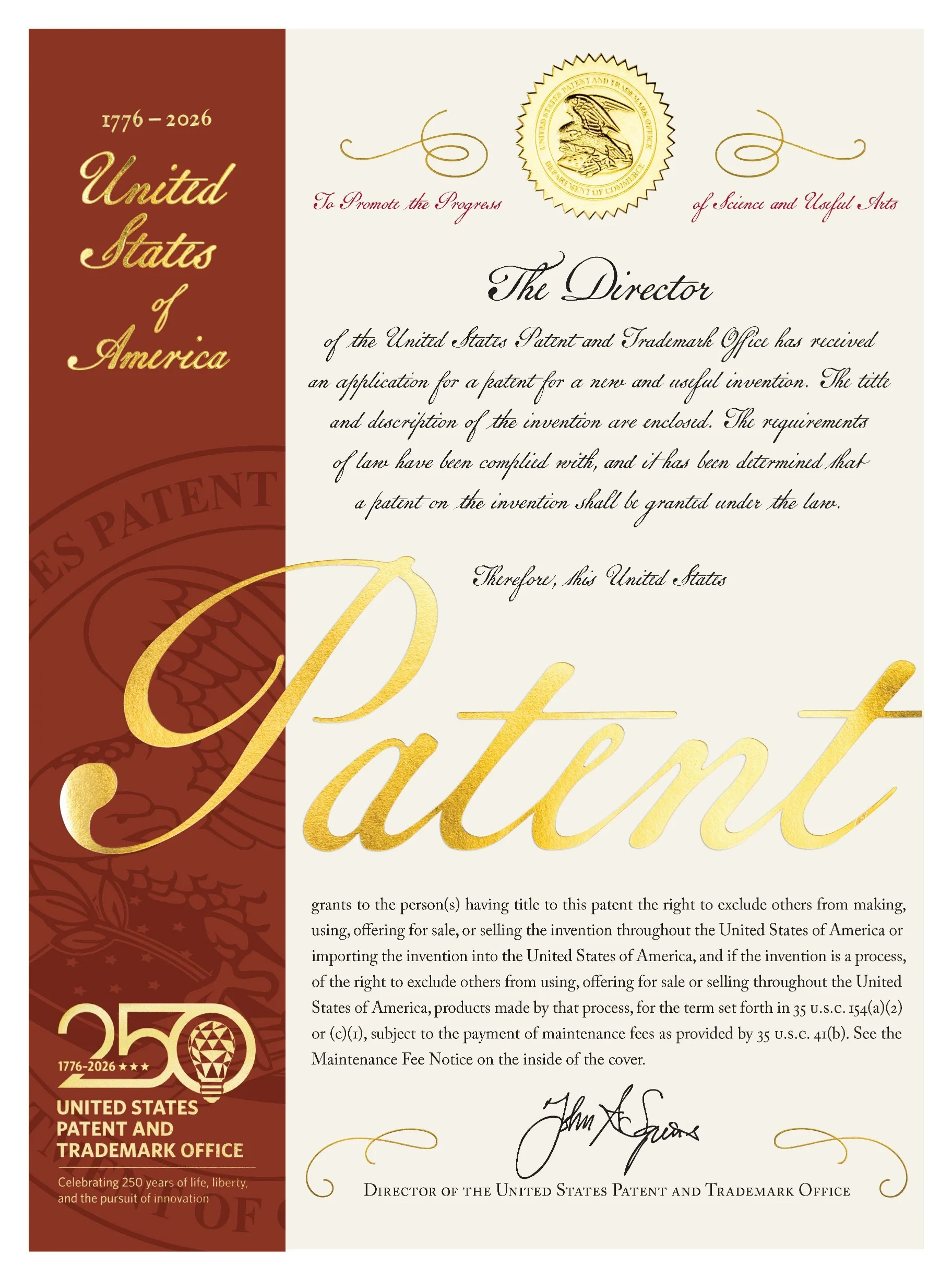
US Patent 12,691,241
Breathing Assistance Apparatus